Greg claims he had a girlfriend in 1997 but the reason nobody ever met her was because she lived 30 minutes away, but seriously, guys, he totally had a girlfriend. Srsly. Don’t worry Greg, I believe you. He also shares some thoughts on Pinkerton, for what it’s worth. Mini-spoiler: He’s still cool with it. Part 2 after the jump.
 From: Greg Schmidt
To: Brandon Hall
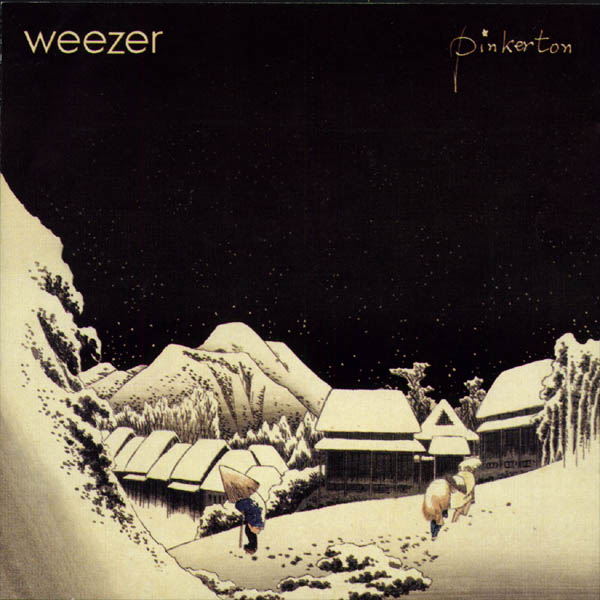
Before I get into things, here’s a little background: Although the Blue Album was a permanent fixture in my Walkman in 1994, I didn’t run out to buy Pinkerton when it debuted. I can’t say if it was due to the poor reviews, but I do remember that suddenly, almost overnight, Weezer stopped being cool and therefore disappeared from my MTV driven life. I didn’t listen to Pinkerton until 1997 when I started dating my first real girlfriend. She lived about 30 minutes away and gave it to me one night before I drove home. For obvious reasons, songs like “Across the Sea” and “Falling for You” hit close to home. With that said, I’ll try to set my nostalgia aside in order to objectively tackle why I still think this is a great album.
After a couple of spins, the first thing that struck me was how unabashedly honest it is, as you noted. This is Rivers Cuomo really hanging it all out there, good and bad, and that’s something I respect, both now and when I was an angst-ridden teen. The “open wound for you to see” quality spoke to me in 1997 in a way I assume Dashboard Confessional connected with teens of the 2000s. Musically, Pinkerton is a beast. It’s raw, angry, and yet still very pretty at times. Matt Sharps’ unhinged backup vocals make me want to lurch around the room and belt out every song with careless abandon. I think it’s important to note that the exit of Matt Sharp after this album also makes Pinkerton special in the way that a dying man’s last words become a precious commodity.
Lyrically, I agree that it’s simple and immature at times, but I find that kind of endearing, like when I listen to early Beach Boys and Beatles. What I find really fascinating is how it traces the transformation of Rivers’ adolescent views on women as it grows and becomes more mature and thoughtful. The songs were written over a number of years and track on the album in that linear order. In “Tired of Sex” women are portrayed as creatures of lust. Then they become something of a threat in “Getchoo” and “Why Bother.” Later in “Across the Sea” and “El Scorcho” they’re objects of fantasy. “Pink Triangle” is the first to admit that love needs two sets of compatible wants and desires. And finally, “Butterfly” is an apology for objectifying women, and shows real personal insight. The album plays like a coming-of-age story, and that’s something I didn’t get when I was 17.
I think the failure of Pinkerton had a terrible amount of influence on the present day Weezer. This is apparent on the incredibly formulaic and impersonal follow-up Green Album that had Rivers hiding behind cheesy hooks, gimmicks and a mathematicians approach to songwriting that I assume came from too many music theory classes. So yeah, I still think this is a great record. I think a 10/10 from Pitchfork is ridiculous, but I find most of Pitchfork’s reviews to be highly influenced by current sentiment rather than an objective critique. In my opinion, Pinkerton’s an 8. It’s a good album that should have been the bridge to a stellar third album. Unfortunately, that album never came.
“If everyone’s a little queer, can’t she be a little straight?”
Greg
Download Weezer – The Good Life (mp3)


 AudioVole
Discussion
No comments yet.