All four parts, together in one place for your reading enjoyment!
 From: Brandon Hall
To: Greg Schmidt
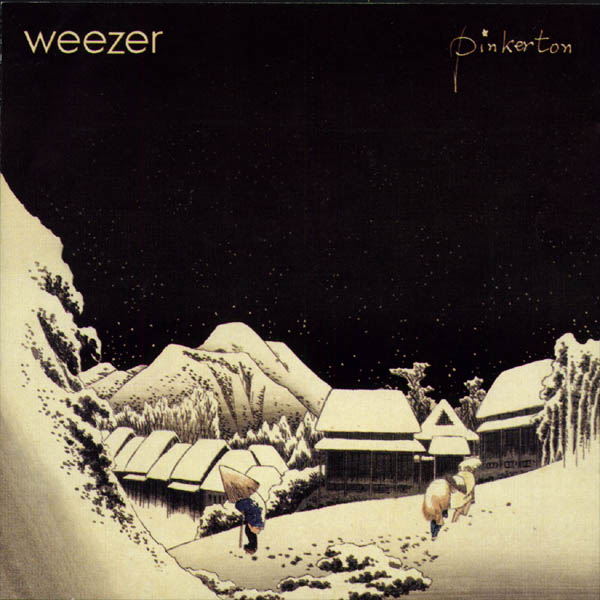
Weezer’s sophomore album, Pinkerton, has seen every level of critical response possible in the 15 years since it was released. In 1996, the Rolling Stone readers ranked it the second worst album of the year. According to Wikipedia (thanks again!), a reviewer from Melody Maker advised the listener to “ignore the lyrics entirely.” Rob O’Connor at Rolling Stone wrote, “As a songwriter, the band’s singer and guitarist, Rivers Cuomo, takes a juvenile tack on personal relationships,” which is certainly true, but adds for good measure, “Weezer over-rely on catchy tunes to heal all of Cuomo’s wounds.” Which is also true. Even Rivers hated it, telling Entertainment Weekly in 2001:
“It’s a hideous record… It was such a hugely painful mistake that happened in front of hundreds of thousands of people and continues to happen on a grander and grander scale and just won’t go away. It’s like getting really drunk at a party and spilling your guts in front of everyone and feeling incredibly great and cathartic about it, and then waking up the next morning and realizing what a complete fool you made of yourself.”
But then, like, in retrospect, everyone seemed to love it. When Geffen reissued Pinkerton as a Deluxe Edition, Pitchfork gave it a 10! All Music also gave the album a perfect 5 stars. Even Rivers, I guess, came around, telling Pitchfork in 2008, “Pinkerton‘s great. It’s super-deep, brave, and authentic. Listening to it, I can tell that I was really going for it when I wrote and recorded a lot of those songs.” And anyone who still admits to being a fan of Weezer clarifies that, well, at least “the Blue Album and Pinkerton are amazing.”
Greg, I am really excited that this is the second Crate Digging dialectic we’ve done at AudioVole, considering the first was Green Day’s Dookie, an album released in 1994, the same year as Weezer’s debut and much celebrated Blue Album. Serendipitously, Green Day is called out by name on Pinkerton in “El Scorcho!” Both bands are still around but their careers have taken very different trajectories. Green Day won a Grammy for American Idiot in 2004. Weezer’s 2005 album Make Believe was given a 0.4 on Pitchfork, which is remarkable only for the silliness of its score, and any time I run into someone over the age of 18 really excited for the new Weezer album, it has become increasingly difficult not to yell out, “What is wrong with you?” and even harder to disguise the judgment, disdain, and pity writing novels of scorn across my face. If you’re into Green Day, I just think you’re kind of lame.
I’m also excited to talk about the album, because I’d like to decide, once and for all, how I feel about it. Taken only in the context of other Weezer albums, it’s easily, obviously the second best of the lot, so is it great by comparison only? Is it objectively great? Does it deserve Pitchfork’s 10? Or is that the nostalgia talking? Every few years, I decide to give Pinkerton another go, and I usually have the same reaction. I really dig it for a week or two, then it starts to grate and annoy, I say, “Sure as shit not as good as the Blue Album,” and put it away.
Having spent the past few days listening to it again, this is my brief assessment: The songs are catchy and they rock. I want to play them loudly and jump around while listening to them. Opener “Tired of Sex” is all kinds of awesome, has a great opening with that weird keyboard sound, pounding drums, and kick-ass bass line, and feels both reminiscent of Green Day (the bass line) and Nirvana (the guttural yelps towards the end of the song.) But the songs are also painfully and shamefully on the nose, lyrically. One after another, they are the confessions of an emotional infant — pure, unadulterated id that definitely verges on the creepy — “So I went to your room and read your diary,” he says in “El Scorcho” about a girl he’s supposedly never even talked to.
Emotional honesty is very important to me. And confessional songs have a glorious and expansive place in our pop music history. But while I really can’t take issue with any individual song, and I think any of them would be an excellent addition to a Weezer album, piled together as a whole, the result is overwhelmingly pathetic. It’s like 35 minutes of listening to your friend whine about girls and how there’s no point in talking to any of them because they probably won’t like him anyway. At least it’s only 35 minutes, I guess.
So, Greg. I know you loved Pinkerton, which is one of the reasons I wanted to do this album with you. Do you still love it, or has it changed for you? And what, if any, affect do you think this album has had on Weezer’s career? Is it the reason Rivers can’t/won’t write any more interesting music?
“I’m a lot like you, so please, hello. I’m here. I’m waiting,”
Brandon
Download Weezer – El Scorcho (mp3)
From: Greg Schmidt
To: Brandon Hall
Before I get into things, here’s a little background: Although the Blue Album was a permanent fixture in my Walkman in 1994, I didn’t run out to buy Pinkerton when it debuted. I can’t say if it was due to the poor reviews, but I do remember that suddenly, almost overnight, Weezer stopped being cool and therefore disappeared from my MTV driven life. I didn’t listen to Pinkerton until 1997 when I started dating my first real girlfriend. She lived about 30 minutes away and gave it to me one night before I drove home. For obvious reasons, songs like “Across the Sea” and “Falling for You” hit close to home. With that said, I’ll try to set my nostalgia aside in order to objectively tackle why I still think this is a great album.
After a couple of spins, the first thing that struck me was how unabashedly honest it is, as you noted. This is Rivers Cuomo really hanging it all out there, good and bad, and that’s something I respect, both now and when I was an angst-ridden teen. The “open wound for you to see” quality spoke to me in 1997 in a way I assume Dashboard Confessional connected with teens of the 2000s. Musically, Pinkerton is a beast. It’s raw, angry, and yet still very pretty at times. Matt Sharps’ unhinged backup vocals make me want to lurch around the room and belt out every song with careless abandon. I think it’s important to note that the exit of Matt Sharp after this album also makes Pinkerton special in the way that a dying man’s last words become a precious commodity.
Lyrically, I agree that it’s simple and immature at times, but I find that kind of endearing, like when I listen to early Beach Boys and Beatles. What I find really fascinating is how it traces the transformation of Rivers’ adolescent views on women as it grows and becomes more mature and thoughtful. The songs were written over a number of years and track on the album in that linear order. In “Tired of Sex” women are portrayed as creatures of lust. Then they become something of a threat in “Getchoo” and “Why Bother.” Later in “Across the Sea” and “El Scorcho” they’re objects of fantasy. “Pink Triangle” is the first to admit that love needs two sets of compatible wants and desires. And finally, “Butterfly” is an apology for objectifying women, and shows real personal insight. The album plays like a coming-of-age story, and that’s something I didn’t get when I was 17.
I think the failure of Pinkerton had a terrible amount of influence on the present day Weezer. This is apparent on the incredibly formulaic and impersonal follow-up Green Album that had Rivers hiding behind cheesy hooks, gimmicks and a mathematicians approach to songwriting that I assume came from too many music theory classes. So yeah, I still think this is a great record. I think a 10/10 from Pitchfork is ridiculous, but I find most of Pitchfork’s reviews to be highly influenced by current sentiment rather than an objective critique. In my opinion, Pinkerton’s an 8. It’s a good album that should have been the bridge to a stellar third album. Unfortunately, that album never came.
“If everyone’s a little queer, can’t she be a little straight?”
Greg
Download Weezer – The Good Life (mp3)
From: Brandon Hall
To: Greg Schmidt
Greg, you brought up a lot of really good points and I fear this format is not perfectly suited to our ends because I want to touch briefly on a lot of things you said and it may feel a bit like a list, so bear with me.
In fact, I’m just going to make a list.
1. My first girlfriend also lived 30 minutes away! It was maybe even closer to an hour. And while she was no where near as cool as your GF – she did absolutely nothing by way of turning me on to music – the drive to and from her house did drastically deepen my appreciation for Outkast, The Roots, and Queen, the three artists I think I was into that summer. I think Queen made the rotation because my mother had just bought their Greatest Hits or something. Anyway, car time was, and remains, great music time. Do you miss it? You ride your bike exclusively, now, so when do you imbibe in sweet dulcet melodies?
2. Unabashed honesty can be good and fresh and rewarding so long as it isn’t purple and clichéd, which I think much of Pinkerton is. It’s what makes “emo” music so gag-worthy. So, yes, the album probably has a lot in common with Dashboard Confessional, though I find a lot of early Beatles and Beach Boys tracks to be at least a little more clever with their lyrics and arrangements, even on something as straightforwardly cheesy as “I Wanna Hold Your Hand.” Also, I think they were, as artists, more calculating than Cuomo and Weezer. I’m not sure Rivers was trying to nail the preteen demo in the same way The Beatles, The Beach Boys, or, like we mentioned in our last Crate Digger, Green Day with Dookie.
I think Cuomo was absolutely writing from the heart. And I think he showed himself to be kind of a lousy poet, which is actually surprising because their debut had a lot of great, fun songs that featured such a clever mix of wit, confession, and nostalgic imagery. Cuomo wrote a lot of Pinkerton on the influence of painkillers, so maybe there’s that. Of course, Matt Sharp sued for writing credit on 9 of the 10 songs and won a settlement out of court, so is he to blame, as well, or should we give him the lions share of credit for the kick-ass music?
3. Matt Sharp leaving after Pinkerton and Weezer’s subsequent fall from rock grace feels a whole lot like Jay Bennet’s involvement with Wilco and his departure after their seminal Yankee Hotel Foxtrot. Both bands featured front men who take all the credit, but the quality and creativity of both fell off after their “lesser” disgruntled members left the band. Perhaps losing Matt Sharp has as much to do with the decline of Weezer as the public reception to Pinkerton.
4. Also, I wonder if you’d care to tackle the similarities between Pinkerton and Pearl Jam’s Vs. Of course, both albums follow huge debut successes, Blue Album and Ten. Both have black and white covers. Both bands rejected commercialization of their albums, especially in the form of music videos, though Pearl Jam had much more clout to be able to do so. After the video for “Jeremy” became such a hit, they refused to do any videos for Vs. wanting people to focus on the music, not the video. Weezer, similarly, rejected Spike Jonze’s treatment for “El Scorcho,” then argued with Mark Romanek so much that he quit, leaving them to finish production and editing of the video themselves. And it kind of sucks. For their next single, “The Good Life,” they upped the ante significantly to try to salvage the album’s plummeting sales but the damage seemed to have been done.
It is interesting to think about the frustration and conflicted feelings that a musician must have had at the heyday of music videos, in which their music frequently became a score for a director’s short film. Weezer’s “Buddy Holly” will forever be remembered for its Happy Days video. When you think of the Beastie Boys’ “Sabotage,” one thing comes to mind. How can you think about Jamiroquai without seeing a man in a big fur hat walking around on a conveyor belt floor?
Here’s my last question for you and it’s a little off topic re: Pinkerton. How do you feel about music videos and their place in the dissemination and proliferation of music, especially now that the videos have moved to the internet and seem so much less prolific, or at least relevant, in today’s environment? Did they, as Weezer and Pearl Jam asserted, detract from or change the perception of the music? And if Weezer had played along, had played the game, had “sold out” so to speak, would Pinkerton have suffered a different fate?
“Shaking booty, making sweet love all the night,”
Brandon
From: Greg Schmidt
To: Brandon Hall
I guess, for me, what makes Rivers lyrics tolerable is his self-deprecating nature. This is obvious in “Falling for You” when he refers to himself as “little old 3-chord me.” Even when he says ridiculous things, I always feel like he’s winking as he says them.
I agree with your comparison of Matt Sharp leaving to Jay Bennet’s departure from Wilco. When great bands lose members and leave only one strong creative force, I usually find their new work less interesting. It’s not always productive to go unchallenged when writing music. You need a strong personality to sometimes say, “sorry, dude, but that guitar solo sucks. Let’s write a new one.” Weezer is now the Rivers Cuomo show and I’m no longer interested.
I think a catchy music video for “El Scorcho” could have helped immensely. The album needed a gimmick to get people on board for an album that was going in a new direction. But honestly, I don’t really care for the song and always felt like it solely existed to be the single that fans of Blue Album could swallow. “The Good Life” with a Spike Jonze video would have been a better debut. I think the reason Pearl Jam’s Vs got away with skipping the videos is that the album really is a 10 out of 10 and was embraced both by fans and critics.
I think that the combination of music and video can create powerful results as seen in the “Jeremy” video. That music video really added a new element that made it into something more than just a song. In regards to Weezer, how much more silly did the video for “Buddy Holly” make that already ridiculous song? I thinks it’s totally fitting. And when it came time to do the “El Scorcho” video, what were they afraid of? It’s not like the song had any deep message that could have been distorted. So yeah, I think they blew it when they lost Spike Jonze for the video. He probably could have pushed them up in the charts again. But even if Pinkerton had been successful, I wonder if the path of Weezer would have changed significantly. Rivers was already disenchanted with the business and his relationship with Matt Sharp was probably already strained. But maybe they would have held together for one more great one.
By the way, did we figure out if Pinkerton’s a great album? What’s the final score?
“At ten I shaved my head and tried to be a monk,”
-Greg
 From: Brandon Hall
To: Greg Schmidt
You know, I thought of another apt comparison: Wes Anderson’s movies were always so much better when he had to fight tooth and nail with Owen Wilson on the script. Wes Anderson sans Owen Wilson = hubristic pretentiousness without soul. Just like Weezer’s Green Album! And everything since.
As for “song that would fit best on the Blue Album,” I kind of feel the honors fall to “The Good Life.” It just has that hard, danceable vibe that could fit perfectly between “No One Else” and “The World Has Turned and Left Me Here.” But honestly, I just perused Blue Album to see where I would put “The Good Life” and was immediately struck by how much Blue CRUSHES Pinkerton! I’m definitely biased, and can’t claim otherwise, but none of Pinkerton’s songs can hold a candle to anything on the Blue Album (with the possible exception of “Surf Wax America”). And Greg, I know you won’t have a chance to respond to this because it’s our last post, so I’ll just note that I expect you disagree on this point.
As for Cuomo’s fear that videos distract from the austerity of his music, I think that’s just massive egotism destroying the fun quirkiness that made the Blue Album great. Rivers is obviously a very conflicted individual who can pen self-deprecating lyrics, and then turn around and posture like his songs are sacred, not to be sullied or thrust into the shadow of a music video. Remember, Pinkerton was released in place of the rock opera, Songs from the Black Hole, Weezer had initially been working on. Rock operas = sure sign someone is taking himself too seriously. As for the music videos, I imagine he mostly didn’t want someone else getting credit for the popularity of his song. I imagine he saw Spike Jonze’s creativity and popularity as a threat.
Interestingly, did you know “The Good Life” was directed by Jonathan Dayton and Valerie Faris about 10 years before they directed Little Miss Sunshine, and now they have almost as much clout as Spike Jonze? It also starred Mary Lynn Rajskub, another Little Miss Sunshine alum, who never fails to rock my world.
You gave Pinkerton an 8/10. I think I’d give it a 7/10. Maybe a 7.5/10. Which puts me pretty close to your score, actually. I don’t think it’s a great album. Certainly not transcendent in the way the Blue Album is. But it is good. A lot of the songs are catchy, and almost all of them are fun, taken individually. But I’m ready to put it away again. We can reunite in five years.
Until then, “why bother? It’s gonna hurt me,”
Brandon


 AudioVole
Discussion
Trackbacks/Pingbacks
Pingback: 2011 Crate Digging Retrospective « AudioVole - November 29, 2011
Pingback: 2011 Crate Digging Retrospective (Pts 1-4) « AudioVole - December 4, 2011