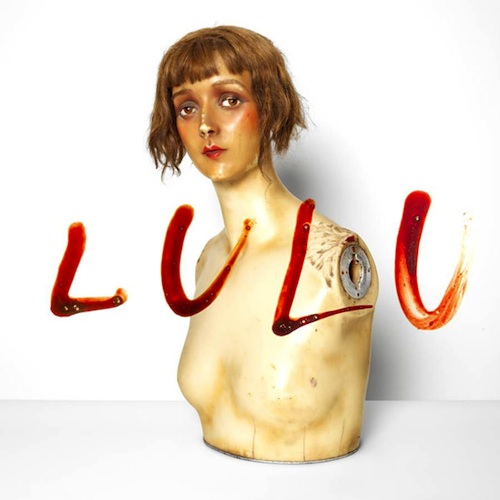
Now this is what I call a tangent! We came to talk about Loutallica’s Lulu and ended up with our own little polemic about Camp. By the end of this dialectic, you won’t even need to read Sontag’s “Notes on Camp” because Jenn and Brandon will have transcribed the whole damn thing. But hey, at least we don’t have to listen to Lulu anymore!
Example of Camp – “King Cry Baby” from John Waters’ film Cry-Baby
 From: Jenn Lao
To: Brandon Hall
Kafkaesque. A giant roach with an apple embedded on the side of his body? That’s Camp. No? One sign of Camp, for me, is the lingering feeling of “wtf, did I just dream that?” Metamorphosis isn’t cruel, it’s bizarre. Dude’s a giant roach.
OK. Pause. The Metamorphosis isn’t tacky, just eerie…I guess. So does Camp need to lack taste? Does it just have to be pointless and stupid? I can negotiate where the Metamorphosis goes, but the socks stay.
I Heart Huckabees poked fun at existentialism, but it could have very well been Camp they were making fun of in a Campy way. That movie exemplified scenes of Camp in the context of existentialism. How is Sontag’s definition below different than the definition of Camp? Seriousness, check. Anguish, Cruelty, Derangement, check, check, check.
What am I missing?
Jenn
More Camp – “Time Warp” from Rocky Horror Picture Show
 From: Brandon Hall
To: Jenn Lao
Well, like, I have to use Sontag, here, because “Notes on Camp,” the whole essay, was definitive. There’s not an easy, one sentence definition, because she was trying to pin down and examine something as ephemeral and nebulous as a cultural “sensibility.” She made 58 points in an attempt to exact specifically what it is we call Camp.
Anguish, cruelty, and derangement are not necessarily elements of Camp. Rather, Sontag used those descriptions in discussing one of the main sensibilities of art, of which she notes three:
- The seriousness of high culture and the high style of evaluating people.
- “The seriousness whose trademark is anguish, cruelty, derangement.” Examples she gives include Bosch, Sade, Rimbaud, Jarry, Kafka, and Atraud.” This sensibility creates “art whose goal is not that of creating harmonies but of overstraining the medium and introducing more and more violent, and unresolvable, subject matter.” Within this sensibility, “something is good not because it is achieved, but because another kind of truth about the human situation, another experience of what it is to be human is being revealed.” That’s what we get from Kafka and the Metamorphosis. Gregor’s transformation into a cockroach is a poignant metaphor about one’s work and obligation to work, to earn money, robbing that person of their humanity and exposing the inhumanity of everyone around him. It’s not Camp because it doesn’t fail. As Sontag notes:
- “And third among the great creative sensibilities is Camp: the sensibility of failed seriousness, of the theatricalization of experience. Camp refuses both the harmonies of traditional seriousness, and the risks of fully identifying with extreme states of feeling.”
All John Waters’ films are Camp. Rocky Horror Picture Show is Camp. The Room is Camp. Classical ballet and opera are prime examples. It’s about artifice over substance. It’s about style, about aiming toward seriousness and shooting way past it. I would think most soap operas should be defined as Camp. As should most Jean Claude Van Damme, Chuck Norris, and Steven Segal movies. And Robert Rodriguez and a lot of Tarantino. Almost anything that’s “so bad it’s good,” though Sontag finishes her essay by noting that being “so bad it’s good” is not sufficient to categorize something as Camp.
And I bet you could probably make an argument that I Heart Huckabees is ultimately Camp, as well, though I personally don’t think it’s so bad, it’s good. I think it’s just good. The movie is silly and bizarre, but I think it hews more toward that second sensibility of Kafka and Rimbaud than of John Waters.
“Does it just have to be pointless and stupid?” Kind of. “Does it need to lack taste?” Yeah, more or less. It’s specifically flying in the face of taste. “Style is everything,” Sontag points out. “The whole point of Camp is to dethrone the serious. Camp is playful, anti-serious.” Later she says, “One is drawn to Camp when one realizes that ‘sincerity’ is not enough. Sincerity can be simple philistinism, intellectual narrowness.”
“Camp proposes a comic vision of the world,” she writes. “But not a bitter or polemical comedy. If tragedy is an experience of hyperinvolvement, comedy is an experience of underinvolvement, of detachment.”
Camp must therefore be detached from reality, it needs to exist in a world defined by and enveloped in style and overabundance. It is explicitly full of sound and fury, signifying nothing.
(By the end of the week, I will have transcribed all of “Notes on Camp.”)
b
From: Jenn Lao
To: Brandon Hall
So…is that your official response?
Jenn
If you’re into masochism:
Insound Vinyl | eMusic | Amazon MP3 & CD


 AudioVole
Discussion
No comments yet.