Parallax refers to the displacement or difference in the perceived position of an object viewed along two different lines of sight. Clearly Chris and Brandon are looking at Parallax from a different angle than seemingly everyone else. Do I hear science experiment!? Not really. Just another bubble Brandon’s trying to burst.
Stream Parallax with four song writeup from Bradford Cox at NY Times Magazine.
Atlas Sound – “Lightworks”
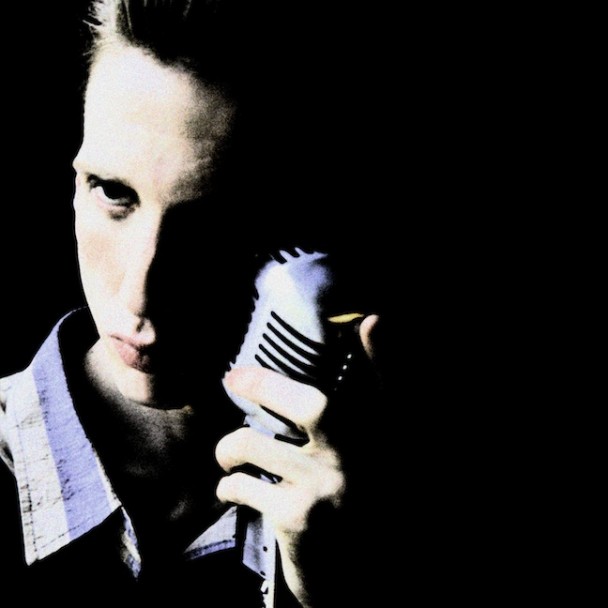 From: Brandon Hall
To: Chris Atto
Ah, dammit. I was hoping you loved Atlas Sound and Deerhunter and could tell me why I should love them, too.
What bugs me is that I don’t know anybody who would claim Deerhunter or Atlas Sound as their “favorite band,” or even put them in their top five. I’ve never met anyone who’s had one of Cox’s albums on repeat for more than a couple weeks, or says they always go back to Microcastles “this time of the year,” or any of the things people say and do when discussing a band or an album or a song that carries a lot of weight for a person.
And I cringe a little every time I bring up Pitchfork and point to what they said or the score they gave, because it is just one person’s and one publication’s opinion. That said, Pitchfork is too big and too undeniably influential to be disregarded. They are now what Rolling Stone was 40 years ago. In the music world, like it or not, what Pitchfork says matters. And so I think it’s a topic relevant for discussion, especially when they pile accolade after accolade on an artist. Especially when that artist makes a ton of music, none of which is particularly memorable. That’s when I get all in WTF mode. I mean, it’s probably only because of P4K that Parallax is getting the NY Times Magazine treatment we linked to at the top of the page, with a full stream and song by song writeup from Cox. The NY Times? Srsly?
I find it particularly interesting that parallax refers to the displacement or difference in the perceived position of an object viewed along two different lines of sight. The NY Times describes it thusly: parallax is the “optical effect wherein our perceptions of various objects’ relative positions depend on our distance from them — if you drive down a highway, the tree line whizzes past while faraway objects like the sun barely move at all.”
So, maybe to understand Parallax, we need to take into account our distance from it and the angle of our perception. I get the feeling that, when forced to examine Cox’s music from an intellectual perspective, one that takes into account song structure, influences, production, lyrical allusions, genre subversion, etc., a critic might come away with a wealth of goodies to gnaw on. It’s hard to find an article about Cox that doesn’t use the word “genius” or some derivation thereof at least once. Of course, a lot of artists who’ve historically been called “geniuses” have not been very good at making pleasing or approachable art. Gertrude Stein, David Foster Wallace, Frank Zappa, John Berryman, Maya Deren, David Lynch, PT Anderson. The list goes on, obviously. I adore most of these artists, and wouldn’t necessarily count Bradford Cox in their ranks, except to make the point that something can be intellectually satisfying while still being viscerally or accessibly dull. Music theory triptychs can be interesting but there’s not a whole lot that can grab you like three repeating power chords and an anthemic chorus.
From a certain perspective, I can understand how every Bradford Cox release has incited reviewers to declare it a masterpiece, but if we step back and look at these albums from a distance, individually and as a whole, we’re not left with much to hang our hat on, and those Pitchfork scores look ever more inflated. Parallax is no different than any of the others, and I’ll probably forget about it as early as next week.
Also, that Twin Sister album is awesome. And I only had Nyquil. You can pick it up at your local drugstore.
“Gave me bruises after the first time,”
Brandon
Parallax is out 11/8 on 4AD.


 AudioVole
Discussion
No comments yet.