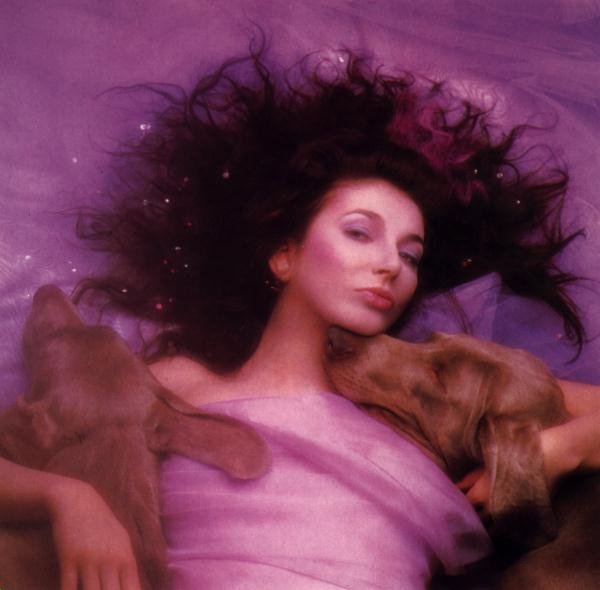
Kate Bush just released her tenth studio album and first in six years, 50 Words for Snow. So are we covering it? Hell no! That would be too easy. Instead, we’re going back into the crate to dust off our copy of her seminal, groundbreaking masterpiece Hounds of Love. And man does that sucker hold up! Brandon and Sarah talk about one of the most important and most challenging pop records of the last 30 years.
Kate Bush – “Cloudbusting”
 From: Brandon Hall
To: Sarah Braunstein
So, like, of course we save an album as dense and complex as Hounds of Love to discuss on Thanksgiving week when neither of us are going to feel capable of doing an adequate job dissecting one of the great pop records of all time. But her newest album in six years, 50 Words for Snow, comes out this week and I wanted to take the opportunity to revisit Hounds of Love, her 1985 masterpiece. I started reading a bunch of stuff that’s been written about the album since it was released and realized that, fortunately for us, hardly anyone’s done an adequate job discussing this avant-garde, theatrical, pop record jam-packed with literary and musical allusions. Part of me feels like we should discuss this in a different medium, the conversational essay feeling so lacking in the wake of its subject matter – maybe we should write poems back and forth to one another or trade garage band songs. Honestly, I’ve been listening to this album almost nonstop for a couple weeks now and I feel like I need a couple more months to really parse this thing out.
For instance, did you know the song “Cloudbusting” (and its accompanying video starring a dapper Donald Sutherland) is about Wilhelm Reich? Do you know who Wilhelm Reich is? I didn’t. But Wikipedia tells me that he was an Austrian-American psychiatrist and psychoanalyst who, after fleeing Nazi controlled Germany where he was publicly attacked in a Nazi newspaper in 1933, was imprisoned in America for his controversial studies, which included building a rain machine – the “cloudbuster,” which may have actually worked – and what was derisively referred to as a “sex box” in a bunch of puritan-tastic conservative 50s propaganda. Then, in 1956, 6 tons of his books, journals, and publications were burned under the auspices of the FDA before he died in prison! Dude escapes Nazi Germany only to be imprisoned and have his books burned in America. By the mother fuckin’ F. D. A.
That’s one song. A particularly awesome song. And they’re all like this. Sublimely catchy, intellectually prodigious, danceable pop songs that doctoral candidates could write essays about. Oh, the line of dialogue that opens the titular track (and my personal favorite on the album), “It’s in the trees! It’s coming!”? That’s from a 1957 horror film Curse of the Demon by Jacques Tourneur. I’m telling you, this shit runs deep.
This is a “Crate Digging Dialectic” but I am ashamed to say I didn’t have it in my crate until a few weeks ago. There’s something about being a lover of art, regardless of the medium, that makes unfamiliarity a source of embarrassment. It’s more pronounced, perhaps, with music because it’s so ubiquitous and easy to consume, but anyone who’s been in a conversation with literature nerds only to sulk home and immediately get on Amazon to pick up those books by Calvino and Coetzee and Baudelaire so as to never feel so inadequate again knows the feeling. After spending every waking moment of the past fourteen days with this album, I’m willing to argue that one cannot be a “well-read” appreciator of pop music without knowing Hounds of Love. The music of Bat for Lashes, Lykke Li, Lady Gaga, Zola Jesus, Chelsea Wolfe, Fever Ray, et al. doesn’t exist without Kate Bush, regardless of whether they’re aware of her influence or not. (For the record, Bat for Lashes is definitely aware of her influence. In fact, the similarities in their styles is even more striking than I had anticipated.)
So before I turn it over to you to get your take, I thought I’d give just a little background to set up the rest of the conversation for all of us born in the 80s who clearly missed the boat. Hounds of Love is Bush’s fifth album and the one that really made her famous in America; its first single “Running Up That Hill” pounded its way into the American Top 40 and dominated the British charts for weeks. She recorded and produced the album by herself over the course of two years in the 24-track studio she built in the barn behind her family home and handed it to EMI as a finished product. It was the first album she recorded outside the constructs of the studio, giving her complete editorial control and the freedom to take as much time as she needed. The results and benefits of her new found freedom should not be understated. The album is split into two suites, Side A: “The Hounds of Love” which includes tracks 1-5 and all four of the album’s singles, “Running Up That Hill,” “Hounds of Love,” “The Big Sky,” and the aforementioned “Cloudbusting” and Side B: “The Ninth Wave” which takes its name from Tennyson’s poem, “Idylls of the King” and is a song cycle that Bush describes as “about a person who is alone in the water for the night…it’s about their past, present and future coming to keep them awake, to stop them drowning, to stop them going to sleep until the morning comes.” Bush has said that she feels the two sides constitute two separate albums. Reading this helped me understand the album so much more, because the two sides do feel drastically different, and I was ready to decry the whole’s lack of coherence.
Silly me.
Over to you, Sarah. How has the album changed your life? Also, it’s been mentioned that Hounds of Love may have been a turning point in pop music. Can you point to any evidence of that? And doesn’t it hold up well? I mean, Jesus; it sounds perfectly contemporary and still even a little weird. And one last question: all the artists I mentioned as being influenced by Kate Bush are female. Those are just the people that came to mind. Could you help me in pointing out some men that seem equally influenced by the majesty of the Bush?
(That was a crude joke. I apologize. It’s getting late.)
“It’s in the trees! It’s coming!”
Brandon
Kate Bush – “Running Up That Hill”
 From: Sarah Braunstein
To: Brandon Hall
Brandon,
You say you just got your hands on Hounds of Love? That is really embarrassing. Especially because, at 9 months old, I was bouncing away in my exersaucer to “Running Up That Hill” and discussing Kate Bush’s reference to the Tennyson poem, “Idylls of the King,” in the title of the second half of her album. Granted, no one could understand any of my (valid) points because my discourse sounded like garbled, detached syllables.
You’re smirking now, I can tell. It’s because you know that you actually (and very legally) gave me Hounds of Love just a couple of weeks ago and I didn’t sit down and listen to it until last Wednesday. Me, the one whose iTunes history reveals that my most listened-to tracks are all from bands consisting entirely of women or at least fronted by a woman, did not hear Kate Bush until 7 days ago. This isn’t embarrassing, it’s shameful (slightly less shameful, here’s where I was spending a lot of that wasted time). I’m sorry, Kate, that I read or heard your name referenced and revered in so many places over the years and never took the initiative to crate dig; but really I’m much sorrier for my philistine self.
All of this being the case, I don’t think that I’m quite as…well…floored by this album as you are. I’ve been listening to it essentially without pause for the last few days and while I’m grateful to have more than a passing familiarity with Hounds of Love, I’m not feeling particularly attached to the album either. So far, the only song to get stuck in my head after all the listening I’ve been doing is “The Big Sky” and that track grates on me. I’d like Hounds of Love a lot more if it didn’t have “The Big Sky” on it. As I listen to the album, I also find my ears searching for something in the first five tracks (or Side One, if you will) that isn’t there, and that something is bass. Yeah yeah, I realize bass was not “in” with the synth-happy new wave-y 80s but I was raised on a diet that included the lower register and I miss its warmth and drone in Hounds of Love. Kate Bush is set in her ways (aka touring pretty much NEVER) and so am I.
You’re frowning now because of my negativity, I can tell. To make you stop, I’ll go ahead and say some really nice things about the album now because I believe there are many and they outweigh all of the low points. “Running Up That Hill (A Deal With God),” “Hounds of Love,” and “Cloudbusting” are all fucking awesome songs. I’m pretty sure that “Mother Stands For Comfort” could fit in on St. Vincent’s Strange Mercy exactly as is and no one would bat an eye. If that doesn’t reinforce your point that Hounds of Love sounds contemporary even though it’s 26 years old, I don’t know what will. So we’ll go ahead and add St. Vincent to your all-lady list of Kate Bush progeny.
Speaking of, you challenged me to point to some dudes who might also cite Kate Bush as a major influence and I’ve listed a few below (in no particular order):
- The Decemberists: Colin Meloy loves spinning tales and taking on various personae in all his albums. Kate Bush did that first.
- Arcade Fire: Again, with the story-telling (or attempted story telling). There’s a shared love of multi-multi-multi-instrumentalists as well as less common noisemakers like bouzouki, balalaika, and hurdy-gurdy. Yes, hurdy-gurdy. Also, I’ll be damned if Régine Chassagne didn’t spend some serious time listening to Kate Bush in her formative years.
- M83: You recently wrote about Hurry Up, We’re Dreaming so you get this, right?
- Owen Pallett: Last year, Pallet released Heartland, an album of 12 songs that are described as “monologues from Lewis, an ‘ultra-violent farmer’ in a world called Spectrum, as he tries to come to grips with his own creator, Owen Pallett.” Yeah, he’s definitely into Kate Bush.
- Esben and The Witch: Ok, I’ve never actually listened to these guys but, based on name alone, I can’t imagine how they wouldn’t cite Kate Bush as “totally a major source of inspiration.”
What do you think of this list? And I’m interested to get your take on Side Two of Hounds of Love. This is a meaty subject to be sure, and one that I left entirely untouched for you to delve into. And no, I will not partake in your little game of puns with Kate’s last name. She and I, we’re ladies.
“Mother hides the madman, Mother will stay mum.”
Sarah
Kate Bush – “Hounds of Love”
 From: Brandon Hall
To: Sarah Braunstein
Hey girl. I don’t disagree with Brah’s assessment of transnational migration altering the power structure and changing the political economy by creating new diasporas expressed as concepts, discourses, and experiences; I just want you to move in so we can spend more time together listening to Kate Bush.
There are number of things in your letter that I’d like to rattle off responses to, but feel like I should really get into “The Ninth Wave” half of Hounds of Love. So, quickly, a list:
- I really like “The Big Sky!” But it probably feels the most dated of all the songs on the album. Pause for the jet…
- “Mother Stands for Comfort” is actually the one song I could do without.
- St. Vincent! Ah! Dammit. I knew I was forgetting someone obvious. They even kind of resemble one another.
- No bass!? Hey girl, maybe you just need a better equalizer. The first half of the album absolutely bumps. I mean, it’s not exactly Rihanna but…
- Actually, I think we’re listening to the American pressing of Hounds and I’ve been told that if we really want to hear the album as it was intended, we need to grab the British pressing, the deluxe reissue, or, ideally, a British vinyl pressing.
- Also, don’t tell New Order that bass was not “in.”
- As for male artists, The Field sampled “Under Ice” in his song “Over the Ice” from his awesome debut album, From Here We Go Sublime
- That said, I wouldn’t necessarily list Bush as in influence for The Field
- How can you add Esben and the Witch without ever listening to them!? That’s just lazy. “Oh, they have ‘witch’ in their name. Kate Bush must be an influence.” Tsk tsk.
- Owen Pallett is the most compelling artist on your list of male acolytes. I find the others to be dubious at best, though if we’re going to list The Decemberists, I might go out on a limb and mention Beirut and Neutral Milk Hotel as possible KB torchbearers.
OK. Let’s talk “The Ninth Wave,” the second half of Hounds of Love, which, as I mentioned in my first letter to you, Bush described as being about a person stranded alone in water over night who is visited by her past, present, and future to keep her from falling asleep until morning comes bearing new hope.
Also, perhaps worth noting is the passage within “The Coming of Arthur” from Idylls of the King where the title of this side gets its name: “Wave after wave, each mightier than the last / ‘Til last, a ninth one, gathering half the deep / And full of voices, slowly rose and plunged / Roaring, and all the wave was in a flame.” It’s worth noting because it establishes the terrifying weight of the ocean in contrast to the euphoric weightlessness of the sky embodied by the first half.
From a purely aesthetic sense, “The Ninth Wave” is less enjoyable than “Hounds of Love.” It lacks the bounce and catchiness of the first side, from which all of the singles were culled for a reason. And on the first couple listens, its baroque, theatrical style can be grading and chintzy, reminiscent of a Broadway musical soundtrack. Ultimately, though, this side manages to blow the first half out of the water. It’s dramatically more complex, each of its six songs working in concert to evoke an atmosphere of dread, teetering on the edge between life and death. The theatricality of it all eventually proves itself necessary to adequately execute the ideas Bush is trying to explore. Most importantly, it just seems ballsy. Just, big swinging brass balls. I don’t think you do something like this as an artist with the confidence that it’s going to be awesome. You kind of just close your eyes and swing, muttering, “God, I hope this works.”
Taken as a whole, the album plays like a great, campy horror film, the dialogue lifted from Curse of the Demon at the beginning of “Hounds of Love” acting a bit like Chekhov’s Gun, foreshadowing what’s to come. Not that the first songs aren’t ominous in their own way, but they’re big and bright, focused on the pursuit of love and freedom and happiness, joie de vivre, if you will, just like the beginning of any great horror film. The story inevitably turns, of course, with “And Dream of Sheep” and “Under Ice” where something clearly terrible happens under lilting piano, plucked acoustic guitar strings and sampled spoken tracks in the former, rhythmic strings and a Greek chorus chanting unheeded warnings in the latter.
By “Waking the Witch” we’ve entered a dreamworld marked by a cacophony of spiritual voices, ecclesiastical chanting, pitch shifted demonic duets, and chopped up vocal production, all of which embody a sense of fear and dread I’m hard pressed to find an equivalence to in pop music. At least until our most recent crop of black cloaked songstresses.
“Watching You Without Me” is a cool dirge, a lamentation or message to loved ones left behind, waiting at home for our missing/lost protagonist. Let me come back to this, actually.
“Jig of Life” is a raucous Irish riverdance-like stomp, that Kate had said she wanted to sound like the Irish army marching, and I can’t say it’s not a success. It’s one of my favorite tracks on the album. It rolls and bucks under the driving fiddles and bagpipes that ultimately propel us into space with “Hello Earth” where we float among satellites and spiritual choirs. It’s on “Hello Earth” where all of the elements of “The Ninth Wave” come together – bagpipes and fiddles, layered, pitch-shifted vocals, the chorus, haunted whispers, and sampled dialogue.
The horror finally comes to an end in “Morning Fog,” the resolution of the story, and the happiest, most hopeful track on the album since “Cloudbusting.”
I really didn’t mean to write so much about “The Ninth Wave” but I didn’t know what to say about it without actually digging in. And now that I have, the whole album feels like something that would make Jean Cocteau or David Lynch proud. What I initially saw as incoherence, the two sides being of seemingly different worlds, now feels like a neatly executed three act structure with developed characters and a realized plot. Even “Mother Stands for Comfort,” the one song I didn’t particularly care for, seems to set up “Watching You Without Me.” Bush sings in the former, “She knows I’m doing something wrong…She thinks that I was with my friends yesterday” which works to set up “Watching You Without Me,” after the accident on the ice where she sings, “You watch the clock / Move the slow hand / I should have been home hours ago / But I’m not here.” Plot elements abound, characters repeat, motivations are vivid, there’s set up and pay off. I know Bush said she thinks of these two sides as distinct albums, but there is a clear through line that, while easy to miss on the first few revolutions, is impossible to ignore once revealed.
Like I said, a couple weeks isn’t enough to adequately absorb this album. I’m going to need a couple months.
“You don’t want to hurt me / But see how deep the bullet lies?”
Brandon
Kate Bush – “The Big Sky”
 From: Sarah Braunstein
To: Brandon Hall
So get this: On Wednesday (aka ThanksDrinking) night, I drove back to Michigan and went out to dinner with an old friend at a new-ish gastro-pub that seemed like the best non-chain dining option in the area. Throughout the meal, I noted the “eclectic” mix of music playing overhead which included The Killers, Rod Stewart, and Cat Power. I paid the bill and my friend and I were chatting over the last swallows of our wine when “The Big Sky” came on. Brandon, did you call The Toasted Oak in Novi on Wednesday night and ask them to dedicate a track to me (aka encourage me to drink swiftly and return to my parents’ house to write this)? More importantly, how many times do you think Kate Bush has made it into my life’s soundtrack without me ever realizing it?
Alas, here I am, heeding the orders from the restaurant playlist gods and I have to say that you did a nice job with “The Ninth Wave” round-up. I don’t have much to dispute. Maybe it’s because we’re each other’s audio vole or maybe it’s just that I really like your word choice and general use of adjectives, but I’m starting to get on the same page as you. I think my initial “meh” reaction to Hounds of Love stemmed from a couple of things. First, you really built up the album (yes, this is your fault). I mean, you basically told me to abandon the book/Youtube video/work/FeministRyanGosling in order to listen to Kate Bush’s seminal 1985 album. So I followed your advice and expected to be immediately transported by Hounds of Love. I expected it to be easy. News flash: this album isn’t easy. Sure, the first half is generally accessible and hooky but even the “easy” stuff is darker and more dramatic than most of what makes it on to the radio. For godssakes, the DEMON VOICE makes its first appearance before the opening track is over (see 4:38 on “Running Up That Hill”).
Which brings me to my next musing. When this album was released in 1985, it was a commercial success (insert impressive data about record sales here*). How many people do you think picked up Hounds of Love thinking the whole thing would be as dance-ready as “Running Up That Hill,” only to get to track 6 and beyond and think they took a wrong turn at some point? I mean, “Waking the Witch” is absolutely terrifying. Did the record buyers of 1985 realize what they were getting themselves into? And how many of them quickly decided that “side one might be the side for me,” keeping that record facing the same way whenever it hit the turntable? My gut thinks a lot of folks stayed away from the dark side after one or two spins through but maybe I’m not giving Kate Bush’s fans enough credit.
I actually hope I’m wrong about this because “The Ninth Wave” is what keeps me confused and entranced and likely to return to this album throughout the long haul. I’ll be frank: I don’t get a lot of it. The album’s overall theatricality makes me uncomfortable. The first few times I listened to “And Dream of Sheep,” I glanced at my iPod to make sure some mega-depresso musical soundtrack (synced to my device by a cruel third-party or thespian-developed malware) hadn’t usurped the Bush album. And I guess that’s my biggest complaint about the album as a whole. Bush’s voice is pure and poignant – a strength, to be sure – but she doesn’t keep it in check and some of her arrangements get into Andrew Lloyd Webber territory. I could go for more subtlety in Hounds of Love but that’s not to say it isn’t a masterpiece. Like you, I haven’t parsed it all out yet but listening to the album conjures thoughts of Ophelia, the Salem witch trials, The Lovely Bones (which is unfortunate for many reasons but I’m just being honest here), The Knife opera Tomorrow In A Year and, well, the list of embedded references and post-Hounds referential works goes on and on. Although we’re wrapping this conversation up, it feels kind of like we just got started. Maybe we should sit back down at this table in a few months, once we’ve had some more time to ruminate. Until then, I hope your family’s Thanksgiving involved as much day-drinking as mine did.
“Take my shoes off and throw them in the lake / And I’ll be two steps on the water”
Sarah
*[ed: or here.
#1 UK Albums Chart for ’85/’86
#33 Billboard 200 for ’85/’86
Platinum in Canada and Germany
2x Platinum in UK]
From: Brandon Hall
To: Sarah Braunstein
Yes! Ahahahaha! I did indeed call The Toasted Oak! I knew you’d be there procrastinating. Never question the range and scope of my power, Miss Braunstein. I have eyes everywhere. I’m like a less good looking Tyler Durden.
As for the record sales, it’s kind of hard to deny the radio-friendly attractiveness of those four singles from the “Hounds of Love” side. They do sound weird and a little out there for today’s radio, but her contemporaries at the time were The Talking Heads and Devo and Blondie and Brian Eno and the B-52s. Weird and out there were pretty “in” in 1985.
This album, though, is like an artistic bait and switch. It was Bush’s fifth album, so I doubt her fans were caught off guard by anything other than the album’s greatness. But for the casual fans, the American fans, who “discovered” Bush with “Running Up That Hill” and ran out to buy the record, I bet the B side of this album hit them like a mack truck from their blind spot. I’m sure you’re right that it didn’t get much play on the ol’ phonograph, and is probably the reason it didn’t do better here in the States.
As an artist with fringe or niche sensibilities, though, what more could you ask for? Radio-friendly hits that are weird enough to save face and keep your sanity, but popular enough to attract an audience, and the rest of it, a completely noncommercial suite with irish jigs and demons and heavenly choirs. She got to have her cake and eat it too! Brilliant. It’s like David Lynch making people think Blue Velvet was going to be this cool, Hollywood thriller only to get “He put his disease in me.” Ha. Suckers.
And for what it’s worth, this album would do horribly today, in an age where people don’t have to buy albums, just the individual songs they like. No one would ever get to hear “The Ninth Wave.” Which would be a shame. It’s really what makes the album “seminal” in the first place.
I’m with you. I’m not nearly done talking about this album. We should keep it going. But maybe not publish it. I think AudioVole may have had its fill of Kate Bush Crate Digging for a while.
“Confess to me, girl!”
Brandon


 AudioVole
Discussion
Trackbacks/Pingbacks
Pingback: 2011 Crate Digging Retrospective « AudioVole - November 29, 2011
Pingback: 2011 Crate Digging Retrospective (Pts 1-4) « AudioVole - December 4, 2011