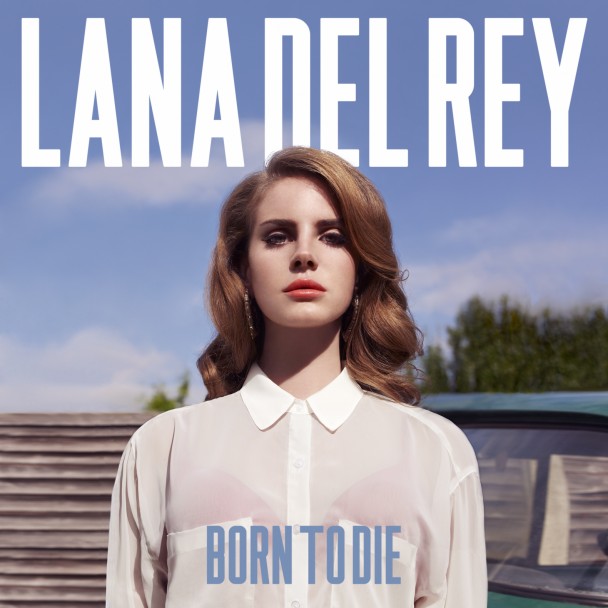
Brandon lets it all hang out, taking what appears to be the role of the Defense in opposition to Ross, who, I thought, was also the Defense. I’m confused. They’re definitely not on the same side, I know that. Yesterday, Ross said Lana Del Rey was a more slender Rebecca Black. (Ouch. Rebecca’s 14, dude. Lay off.) Today, Brandon wants to know, “Why all the hate?” when even her Defense attorney, Mr. Angeles Esq., can’t help but trash her.
Lana Del Rey – “Blue Jeans”
 From: Brandon Hall
To: Ross Angeles
Mr. Angeles, I must say your argument feels about as spurious as Lana’s lips, at least as artificial as her name. You cannot convincingly argue that she as an artist is a record label creation because her stage name was the result of PR firm and managerial brainstorming sessions. A name is a name. As far as I can tell, no other convincing argument beyond speculation has been put forth to prove that the image she espouses or the songs she sings are anything but her own creation. Bette Davis, Kurt Cobain, Nina Simone, and Elvis? You think she couldn’t have come up with those names on her own? She’s a young woman enchanted by fame and glamour, particularly of the 50’s vintage variety. This seems odd to anyone? Name me a pop star on a major label without advisers, managers, lawyers, and a PR team.
So what are we mad about? That Lizzie Grant signed to Interscope and changed her name? Bob Dylan changed his name from Zimmerman. Jon Stewart changed his name from Leibowitz. I’m assuming Madonna once had a last name.
Are we mad that she is inauthentic? And what does that charge mean, anyway? Given the axiom that observing inherently changes that which is being observed, is any celebrity, musician, or artist truly authentic? I don’t understand “authenticity.” Is it Tom Waits? He’s had the freedom to make any music he damn well pleased for decades now, but I have no idea what the dude is like at home and with friends. How about Britney Spears? She’s never not been on a major record label, but don’t you get the impression that with her, what you see is what you get? And is anyone really so naive as to think that the music industry is anything but a cutthroat business? A lot of inauthentic things are dressed up to appear “authentic;” a lot of things are made to look purposely baroque and avant-garde. But no one debates that the goal is to sell records and make money. So why get mad at someone when their angle works, except out of jealousy for not being able to do it yourself?
Is it because she’s an attractive woman? I have to say, I’ve noticed not a little misogyny in many of the critiques against her. Being a famous woman in this country seems like hell. You’re supposed to be pretty, but not too pretty. You should be tough, but not a bitch. You’re not supposed to get old, but if we can tell you had plastic surgery, you’re a charlatan and/or a monster. It always seemed like Hilary Clinton was despised much more than Bill. I never understood the vitriol leveled at Nancy Pelosi, vile epithets that seemed to extend far beyond political disagreement. Is it that Lana Del Rey is pretty but her lips make it seem inauthentically so? Wouldn’t that be true of every woman who wears makeup? And might I point out, she was rather attractive before the colagen injections.
Or is it that she’s pretty but seems untalented? This is the argument I find most noisome, and where I think your comparison to Rebecca Black is most off base. Whereas Black was a musical oddity, a fourteen-year-old performing a song written for/with her by a small Los Angeles record label that became a cultural phenomenon mostly for the unintentional comedy of being so bad, Lana Del Rey exploded onto the scene on the back of “Video Games,” a genuinely fascinating, contradictory, and visceral song whose somber instrumentation belies its obsequious lyrics.
And so what do you mean when you say, “She’s not a valid musician?” Based on whose criteria? The fact that she writes most if not all of her own songs (a fact made painfully obvious on the album) already puts her leagues ahead of many record label flagship bearers who only have to sing and be charismatic, both of which, by the way, Lana Del Rey has proven adept at doing, at least on wax. So she’s a singer/songwriter signed to Interscope. What part of that makes her invalid? The Interscope part? Or is it that you don’t like her music? Which is fine. I’ve listened to the album (told you I would!) and don’t much care for it, myself. But it doesn’t invalidate her as a musician or an artist.
As for the charge that she’s a major label creation, how can we possibly buy that when her whole schtick feels so undercooked? You, yourself, said, “the only thing that is surprising is how clumsy the staging has been.” Doesn’t that make you pause and wonder whether or not there was actually much staging at all? Looking at the timeline, from record label signing to name change to “Video Games” to SNL to LP, it all feels incredibly, haphazardly rushed, especially for an artist who was creating for herself a brand new persona. If we’re being so cynical and callous to believe that Elizabeth Grant is nothing more than a major label pawn, then doesn’t it seem odd that Interscope would trot her out on Saturday Night Live so woefully unprepared? Part of her problem is that she doesn’t even know, yet, what Lana Del Rey’s voice is – a reoccurring problem throughout the album.
There are some really beautifully, fully formed artistic pop-music creations in our very recent past, specifically Nicki Minaj and Lady Gaga. Be they artist-rendered and controlled personas or record label, focus-grouped edifices, those ladies don’t stumble and don’t crack. Saturday Night Live is a really hard venue to play – it’s not in front of an audience, just cameras; the sound is notoriously crappy; you only get one take. But what happened with Lana makes a lot more sense when you look at it as a young woman named Lizzie Grant trying to figure out a character in front of a national audience months before she’s ready than a major label creation manufactured in a factory, prepackaged and ready for delivery. The most likely explanation is that buzz around “Video Games” got too intense too quickly, long before either Lana or Interscope were ready. Interscope leapt at the opportunity and churned out an ill-considered album and under-prepared star in order to capitalize on the surprising buzz of a song that was probably only meant to test the waters. I get the feeling “Video Games” was supposed to be a hint of more to come, rather than an end in itself. But now we have the internet to ruin it for everyone.
Okay. Wow. This went long. And I actually really wanted to talk about her album. So, Ross, by all means, I turn this wonderful discussion over to you, and I’ll pick it up on Friday where hopefully I’ll get to speak my mind about how Born to Die tarnished my love for “Video Games.”
“You so fresh to death and sick as cancer,”
Brandon
Born To Die is out on Interscope.


 AudioVole
Discussion
No comments yet.